Best Way to Verify Temporary Workers Before Placemet
Temporary staffing moves fast, but verification still needs to happen before workers reach a client. Here’s how to build a practical pre-placement verification process that works at scale.
Best Way to Verify Temporary Workers Before Placement
Temporary staffing moves quickly. A client may need 20 warehouse workers tomorrow morning, additional event staff for the weekend, or an urgent replacement for someone who has dropped out of a shift. Recruiters are expected to find suitable candidates, confirm availability and get people ready for placement, often within a very short window.
That speed can make verification difficult to manage. When candidate documents are spread across WhatsApp conversations, email threads and spreadsheets, it becomes harder to tell who has actually completed the required checks and who looks ready on the recruitment tracker.
A good pre-placement verification process should remove that uncertainty without slowing your recruiters down. Here’s how staffing agencies can build a practical process that works for temporary workers and remains manageable as placement volumes grow.
Start by defining what needs to be checked
Before choosing software or changing your onboarding process, decide what your agency actually needs to verify.
The answer will not necessarily be the same for every worker.
A temporary warehouse role may have different requirements from an event worker, delivery rider, contractor or someone being placed in a more sensitive position.
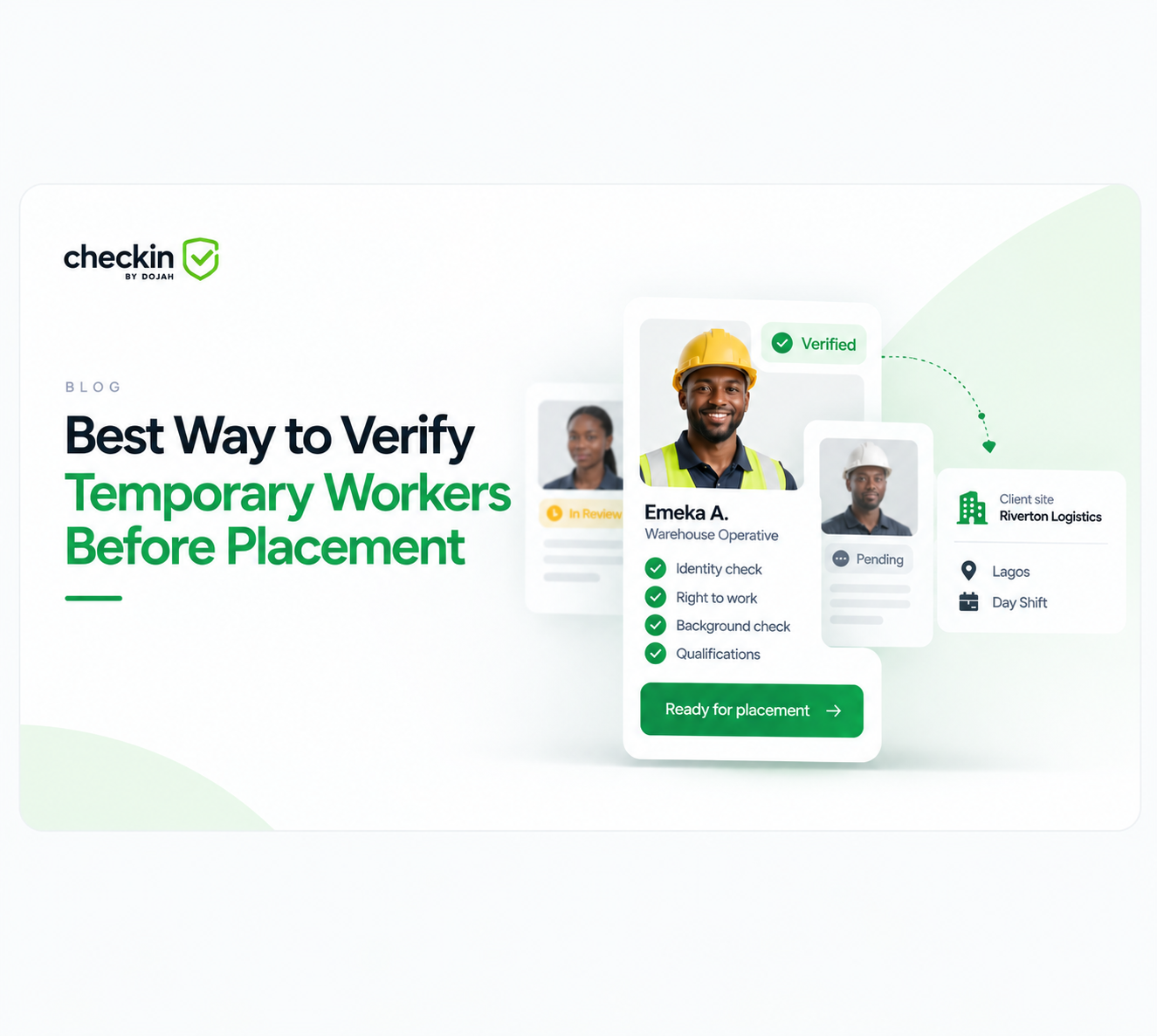
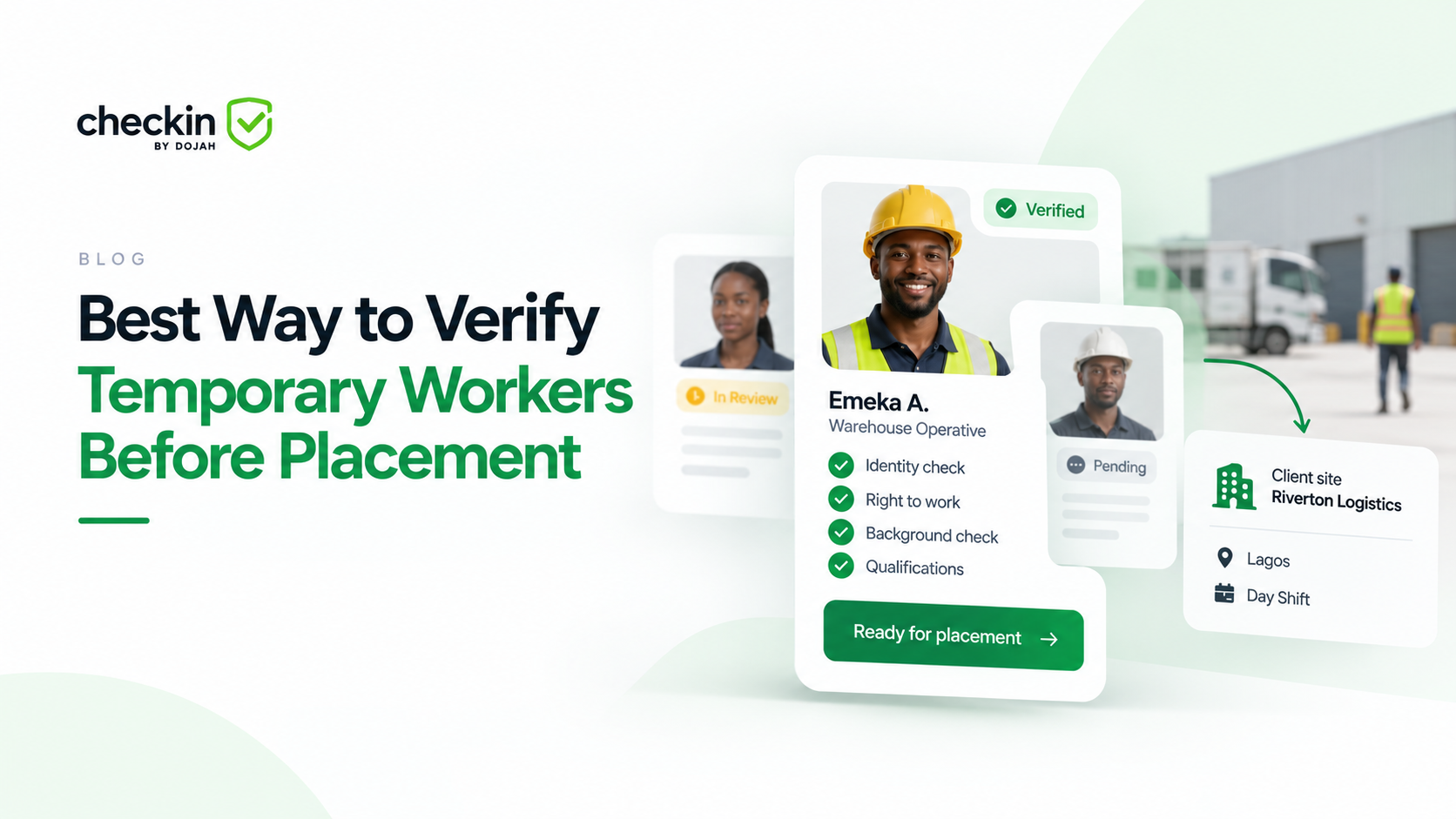
Depending on the assignment and your client's requirements, you may need to confirm a candidate's identity, check the validity of an identity document, perform a facial or liveness check, or collect particular information or credentials before the worker can be considered ready.
The important thing is to define those requirements before asking candidates for documents.
This also helps your agency avoid the habit of collecting information simply because it might be useful later. Candidate identity documents contain sensitive personal information, so there should be a clear reason for requesting and retaining them. Your verification process should reflect the checks that are actually necessary for the role, client or placement.
Verify the right candidates at the right time
Timing matters just as much as deciding what to verify.
If every applicant is sent through verification the moment they express interest in a role, your team may spend time and money checking people who are unavailable, unsuitable for the assignment or no longer interested.
Leave verification until the very last minute, however, and you create a different problem. Your recruiter may believe a worker is ready for tomorrow's shift only to discover that an important check is incomplete.
A more practical approach is to complete the initial screening first. Confirm that the candidate meets the basic requirements of the role, is available for the assignment and is genuinely interested. Once those things are established, the required verification can take place before the placement is confirmed.
The exact point may differ between agencies, but the principle should remain consistent: your team should not have to guess whether the required checks have been completed when it is time to assign someone to a client.
Keep candidate communication and verification separate
WhatsApp is incredibly useful in staffing because candidates actually respond to it. There is no reason to abandon a communication channel that works.
The problem starts when the WhatsApp conversation also becomes the place where verification is managed.
A recruiter asks for an ID, the candidate sends a photograph, the recruiter downloads it and perhaps records something in a spreadsheet. Multiply that process across several recruiters and hundreds of candidates, and information quickly becomes fragmented.
A better approach is to keep using WhatsApp for communication while moving the actual verification into a dedicated process.
Instead of asking:
"Can you send me a photo of your ID?"
the recruiter can say:
"Please complete your identity check using this link."
It is a small change from the candidate's perspective, but an important one operationally. The conversation stays on WhatsApp while the verification itself happens separately.
If your agency currently collects identity documents directly through recruiter chats, read Why Staffing Agencies Should Stop Collecting Candidate IDs on WhatsApp for a closer look at the operational and data-handling problems that can create.
Make verification easy for the candidate too
It is easy to design an internal process around what works for your operations team and forget about the person on the other side of it.
Temporary workers are often trying to secure placements quickly. They may be completing the process between shifts, travelling, or responding to several staffing opportunities at once. If verification involves downloading an unfamiliar app, creating another password, navigating several pages of instructions and repeatedly entering the same information, some candidates simply will not finish it.
And when candidates struggle, the work comes straight back to your recruiters. They start receiving messages asking where to click, whether a document was received, why something isn't working and what the candidate needs to do next. What was supposed to make verification easier becomes another source of administrative work.
A good process should therefore be easy to complete from a phone and clear enough that most candidates can get through it without needing help from a recruiter.
Give the whole team visibility
One of the biggest problems with manual verification is that knowledge tends to sit with individual recruiters.
The recruiter handling a candidate may know exactly what is happening, but what happens when that recruiter is off work, moves onto another client request or hands the candidate over to operations?
Someone else has to piece the story together. At higher volumes, your team needs a shared view of verification rather than relying on personal chat histories or someone's memory. Recruiters and operations staff should be able to see whether the required verification has been completed and identify candidates who still need attention.
That visibility becomes particularly important when several people are working to fill the same client request. Instead of messaging colleagues to ask whether a particular worker has been checked, the information should already be available to the people who need it.
Have a process for candidates who need additional review
Not every verification will be straightforward. Someone may upload an unclear document. Information may be incomplete. A check may require additional review, or the candidate may simply start the process and never finish it.
These situations are normal. The important question is what your team does when they happen.
If exceptions are handled informally, they tend to disappear into individual recruiter conversations. One recruiter follows up immediately, another makes a note to come back later, and someone else may assume the candidate is already cleared.
Your agency should have a consistent way of dealing with incomplete or flagged verification before a worker is assigned. That might mean contacting the candidate for additional information, requesting another attempt or escalating the case internally for review.
The objective is not to eliminate every exception. It is to make sure exceptions are visible and resolved rather than becoming surprises on the day of deployment.
Make one final check before placement
By the time a recruiter is ready to assign someone to a client, verification should no longer be an open question.
Nobody should be asking:
"Did someone check this candidate?"
or searching through yesterday's WhatsApp messages to find out.
The person making the placement should be able to confirm that the checks required for that assignment have been completed and that any outstanding issues have been dealt with.
This becomes increasingly important as an agency grows because the person sourcing a candidate may not be the person who eventually deploys them. A consistent pre-placement check gives everyone the same reference point, regardless of who handled the earlier stages of recruitment.
A simple pre-placement checklist for staffing teams
Before sending a temporary worker to a client, your team should be able to answer these questions:
- Has the candidate completed the initial screening for the role?
- Do we know which verification checks are required for this particular assignment?
- Has the candidate completed those checks?
- Can the relevant members of the team see the verification outcome?
- Have incomplete or flagged cases been reviewed and resolved?
- Is there anything still outstanding that should prevent this worker from being assigned?
If answering those questions means searching WhatsApp conversations, checking several spreadsheets or asking around the office, the problem is probably not your recruiters. The process itself needs more structure.
If you're evaluating tools to support that process, our guide to Candidate Verification Software for Staffing Agencies: What to Look For covers the main things worth considering before choosing a platform.
What changes when your placement volume grows?
A manual process can feel perfectly reasonable when an agency is dealing with five or ten candidates. There are fewer conversations to follow, recruiters know most of the active candidates personally, and missing information is relatively easy to spot.
The same process can become difficult to control when you are handling 100 or 300 people across several urgent client requests.
At that point, the challenge isn't simply verifying an individual candidate. It is making sure the same process is being followed across the entire recruitment team without creating more administrative work every time volume increases.
You need to know which candidates have completed their checks, which ones still require attention and whether the person about to be placed has satisfied the requirements for that assignment.
That is where a structured verification process starts to matter much more than another spreadsheet or another person manually chasing documents.
Make pre-placement verification easier with CheckIn
CheckIn gives staffing agencies a no-code way to create verification flows and share them with candidates through a simple link.
Your recruiters do not have to stop using WhatsApp, SMS or email. They can continue communicating with candidates through the channels that already work for them. When a candidate reaches the point where verification is required, the recruiter sends a CheckIn link instead of asking the candidate to send sensitive identity documents directly into the conversation.
The candidate can then complete the required verification from their phone, while your team manages the process separately from individual recruiter chats.
For a staffing agency, the value is not simply moving documents online. It is having a more consistent way to handle verification before workers are sent to clients, particularly when several recruiters are processing candidates at the same time.
As your placement volume grows, that consistency becomes increasingly important. Your team should not need to rely on someone's memory, an old message or a manually updated spreadsheet to work out whether a candidate has completed the required checks.
Know who's ready before they reach the client
Temporary staffing will always move quickly. Your verification process needs to keep up without becoming another administrative bottleneck.
Before a worker reaches a client, your team should be able to establish that the checks required for that placement have been completed. And as your agency grows, doing that consistently should not require more spreadsheets, more chat searches or more manual coordination between recruiters.
With CheckIn, you can create a no-code verification flow, share it with candidates and give verification a clear, repeatable place in your pre-placement process.
Ready to simplify pre-placement verification?
Create your CheckIn account and start building your candidate verification flow.
Filed under