
Why Staffing Agencies Should Stop Collecting Candidate IDs on WhatsApp
Staffing agencies rely on WhatsApp to collect candidate IDs because it is fast and familiar. But as candidate volumes grow, managing sensitive documents across individual chats becomes difficult to track and scale. Here’s why verification should move out of the chat
Why Staffing Agencies Should Stop Collecting Candidate IDs on WhatsApp
WhatsApp makes recruitment fast and convenient.
A recruiter can message a candidate, request a document, and receive it within minutes (all without introducing new portals, complicated setup steps, or software for the candidate to learn).
For a small agency handling a handful of placements, that setup feels perfectly manageable. But what happens when 20 candidates become 100 or 500?
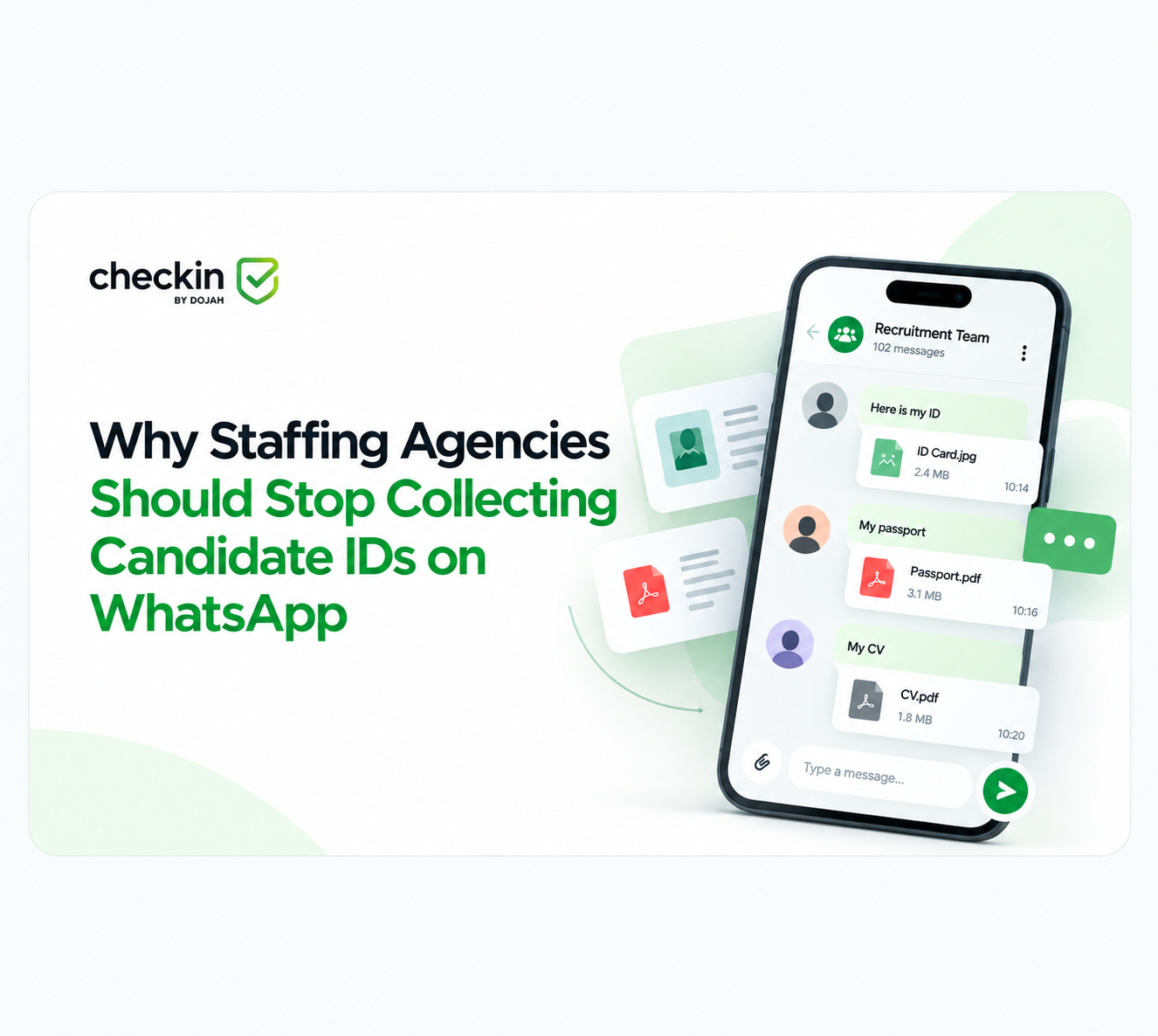
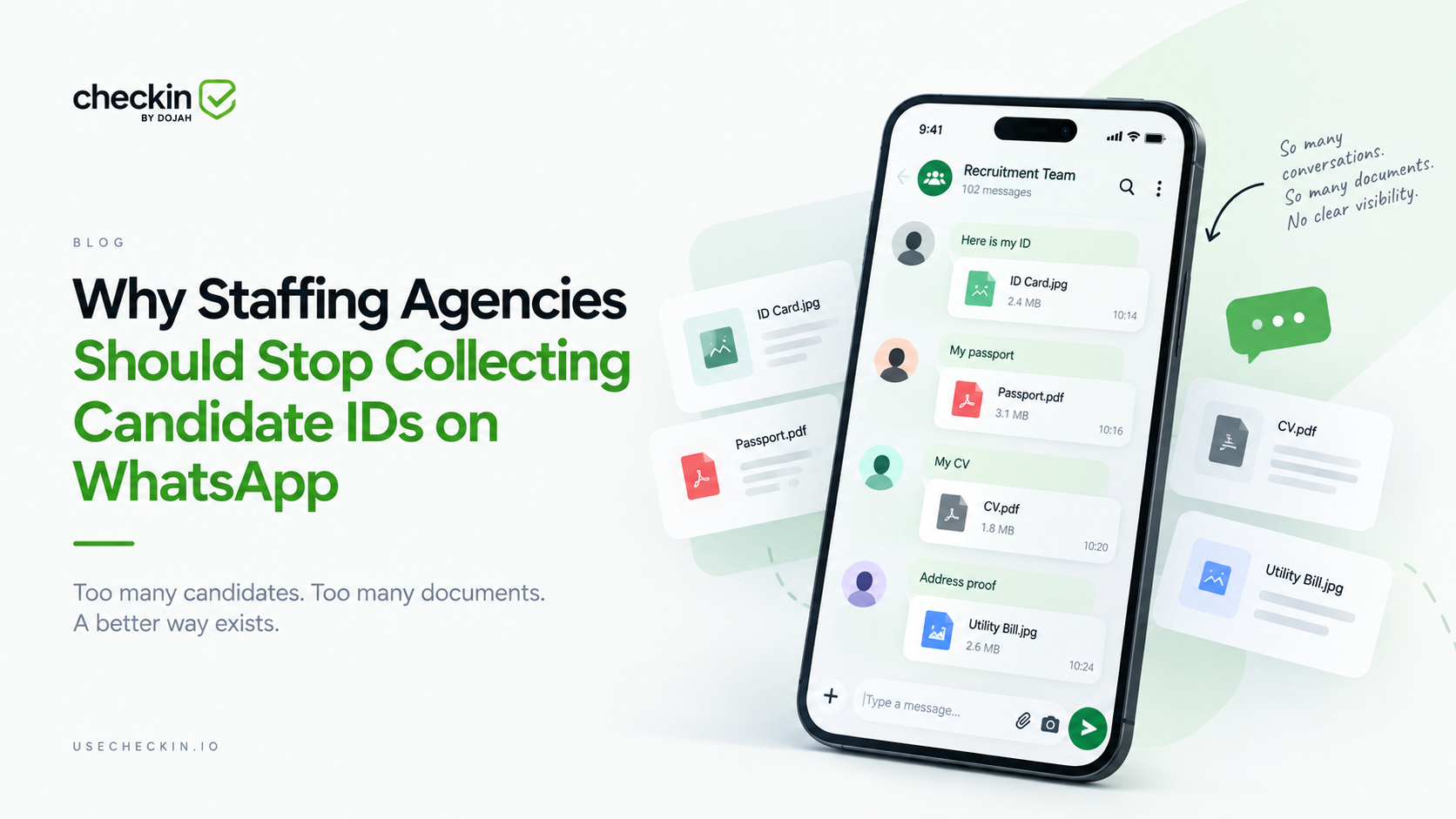
Suddenly, candidate IDs are scattered across dozens of individual chat threads. Recruiters spend hours scrolling through conversations looking for missing files, while candidates send incomplete information or blurry photos. Someone on your team has to manually track who submitted what, who needs a follow-up, and who is actually ready for deployment.
At that point, WhatsApp is no longer just a messaging app: it has quietly become your makeshift onboarding database, and that is where the operational breakdowns begin.
Why Staffing Agencies Collect Candidate IDs on WhatsApp
The appeal of using WhatsApp is obvious: almost everyone already relies on it daily. For recruitment agencies processing temporary workers, event staff, contractors, or other high-volume roles, speed is everything. If a client needs 100 workers on site by tomorrow morning, recruiters cannot afford an onboarding process that slows them down.
In practice, the informal workflow usually looks like this: a recruiter requests an ID, the candidate sends a photo, the recruiter reviews it, logs the details in a spreadsheet, and moves the candidate to the next stage.
It feels simple, but receiving a photo of an ID is not the same as verifying a candidate. A photo only proves that someone has access to a document file; it does not establish that the document is authentic or that the person submitting it satisfies the checks required for the job. As your intake volume grows, failing to make that distinction creates major risk.
1. Candidate IDs Become Unmanageable at Scale
Imagine your operations team onboarding hundreds of temporary workers across multiple client accounts. One recruiter receives IDs via WhatsApp, another takes them by email, a third downloads files to local folders, and a coordinator manually updates a master tracking sheet.
When a client calls to ask which workers are fully verified and cleared for assignment, finding the answer shouldn't require digging through chats, local downloads, and disjointed spreadsheets.
This chaos highlights the core limitation of using a messaging app as an operational workflow. WhatsApp is built for communication, not for providing recruitment teams with a structured, real-time view of candidate verification statuses. As candidate intake increases, the manual overhead required to track documents grows exponentially.
2. Receiving an ID Does Not Prove Who Submitted It
When a candidate sends a picture of a national ID or driver's license over chat, what has your team actually established? Less than you might think. Manual document collection leaves recruiters guessing on several critical points:
- Does this identity document actually belong to the candidate who sent it?
- Is the information consistent with what they submitted on their application?
- Has the document image been altered, cropped, or tampered with?
- Is someone submitting a family member or friend's document to pass initial screening?
- Has the required identity verification actually been completed, or is the file just sitting in a chat queue?
This uncertainty becomes particularly dangerous when recruiting remote, field, or temporary workers who never meet your team in person before arriving on site. Storing candidate IDs in a chat folder is not a verification process: it is simply document storage.
3. Sensitive Candidate Information Needs Proper Controls
Identity documents contain sensitive personal data, and collecting them requires strict operational governance. Every staffing agency handling personal records must answer a few basic questions:
- Who on your team has access to these candidate files?
- Where are the images stored, and how long are they retained?
- Who ensures these files are deleted when no longer needed?
- What happens to candidate documents stored on a recruiter's personal phone when they leave your company?
- Can your business demonstrate audit-ready compliance if requested?
Under data protection frameworks like Section 24 of Nigeria’s Data Protection Act (NDPA 2023), organizations processing personal information must implement appropriate security, access, and retention safeguards. While receiving a document over WhatsApp doesn't automatically violate data privacy laws, leaving sensitive files scattered across individual mobile devices, camera rolls, and shared spreadsheets creates a massive governance liability that high-volume agencies cannot afford to ignore.
4. Manual Document Collection Delays Placements
High-volume staffing is a race against time. Clients need workers placed quickly, recruitment finds the candidates, and operations must clear them for deployment.
Application ──► Screening ──► Verification ──► Assignment
When candidate verification relies on recruiters opening individual chat threads, checking files visually, and updating manual logs, verification becomes the bottleneck holding up the entire pipeline. If your agency handles temporary staffing, event personnel, dispatch riders, or outsourced workers, delays in tracking verification directly translate into delayed placements and lost revenue.
WhatsApp Isn't the Problem
Staffing agencies don't need to ban WhatsApp entirely. Candidates and recruiters already rely on it, and it remains one of the most effective channels for quick communication.
The mistake lies in using the chat conversation itself as the verification system.
Instead of asking candidates to "Please send a picture of your ID in this chat," recruiters can send a dedicated link to a structured verification process. WhatsApp remains your primary communication channel, while the actual verification takes place on a platform built specifically to capture, verify, and organise identity records. That single shift keeps your communications fast while cleaning up your operational workflow.
What a Structured Candidate Verification Workflow Looks Like
Moving verification out of WhatsApp doesn't mean changing how your recruiters communicate with candidates. They can continue using the channels candidates already respond to while giving identity verification its own structured process.
With CheckIn, that workflow can look like this:
- Send a CheckIn verification link: Instead of asking candidates to send ID photos directly in a WhatsApp chat, recruiters send them a dedicated CheckIn link.
- Candidates complete the verification: Candidates open the link on their phone and follow a guided verification flow without downloading another app or creating a complicated account.
- Track verification centrally: Rather than searching through individual conversations to determine who has submitted what, your team can track candidate verification from one place.
- Move verified candidates forward: Verification becomes a clear checkpoint in your recruitment process, making it easier for recruiters and operations teams to know which candidates are ready for the next stage.
The result is a cleaner separation between candidate communication and candidate verification. WhatsApp continues doing what it does best: helping recruiters communicate quickly. CheckIn handles the structured verification process behind it.
When Should Your Agency Move Beyond WhatsApp ID Collection?
If one recruiter handles a handful of candidates each week, collecting documents manually may still feel manageable. The problem appears when that process has to work across more candidates, recruiters, clients, and placements.
It may be time for a more structured verification process if:
- Candidate volumes are increasing;
- Multiple recruiters collect IDs through different conversations;
- Your team regularly chases candidates for missing or unclear documents;
- Verification status is tracked manually in spreadsheets;
- Operations teams struggle to see who has completed verification; or
- Clients require candidates to complete identity checks before assignment.
At that point, the issue isn't whether WhatsApp is convenient. It is whether a process built around individual chat threads can support the volume your agency now handles.
Keep WhatsApp for the Conversation. Move Verification Out of the Chat.
WhatsApp works because candidates already use it. There is no reason to take that convenience away.
But communicating with a candidate and verifying their identity are two different jobs.
As your staffing operation grows, candidate verification should not depend on recruiters downloading ID photos, searching old conversations, updating spreadsheets, and manually figuring out who is ready to move forward.
With CheckIn, recruiters can continue reaching candidates on WhatsApp while sending them a dedicated verification link when it is time to complete their checks. Your team gets a more structured way to track verification, while candidates get a simple process they can complete from their phones.
No complicated implementation. No new app for candidates to learn. No ID photos buried across recruiter chat histories.
Keep the conversation on WhatsApp. Move the verification out of the chat.
Ready to clean up your candidate verification workflow?
Send candidates a CheckIn verification link and manage verification separately from your recruitment conversations.
Create a CheckIn Verification Link
Filed under